
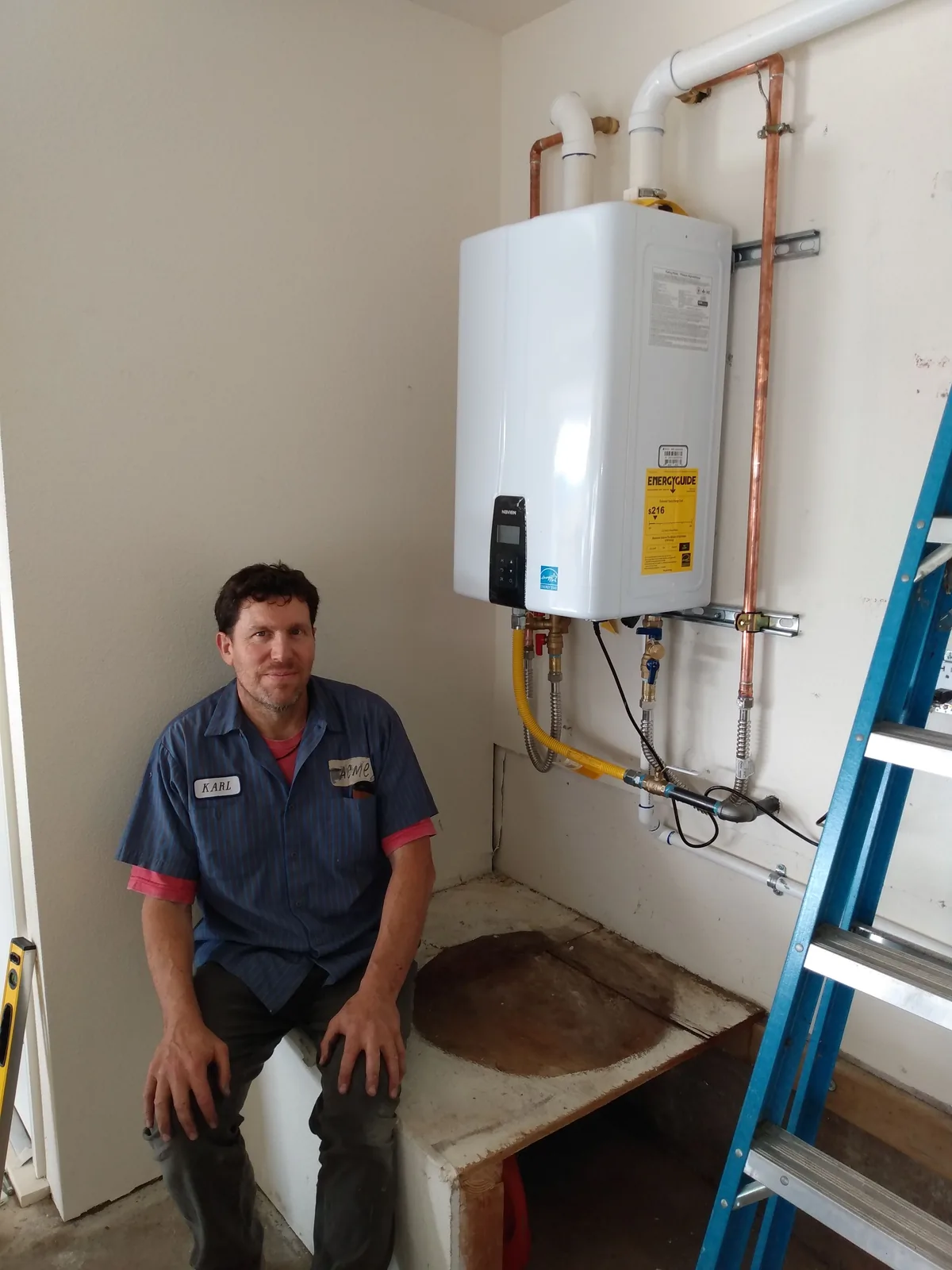
Over ten years, the comparison between a tank and a tankless water heater comes down to four things: what each costs installed, what the install itself requires, how long each lasts, and what maintenance each needs in hard water. Tankless units are documented at roughly twice the service life of a tank heater — around 20 years against 8 to 12 — but the installation is more involved and, in most of Sonoma County, the descaling is not optional. A like-for-like tank swap in the same location on the same fuel is always the cheapest scenario. Whether it is the cheapest over ten years is a different question.
Installed cost
A conventional 40–50 gallon tank runs $2,500 to $2,850 installed. The top of that range is where a drain pan, a second-story location, or a new water shut-off valve forms part of the job.
A Navien tankless unit runs $5,400 to $6,500 installed. The higher figure is a major retrofit or fuel conversion — which is exactly the scenario most homes without existing tankless plumbing fall into.
What drives the difference
The unit is rarely what separates the two quotes. The install is.
A like-for-like tank swap reuses the existing gas line, venting and location. Least work, lowest cost.
A tankless conversion commonly needs:
- A larger gas line. A gas tankless unit draws far more input while running than a tank does. Existing lines are frequently undersized, and sizing is calculated from total demand and run length rather than estimated.
- Dedicated venting. Tankless units cannot share a flue the way an atmospheric tank heater can.
- Condensate drainage, and freeze protection on exterior installations.
- Electrical work if going electric rather than gas — substantial new circuit capacity and often panel work.
California code items apply to both: seismic strapping, a temperature and pressure relief drain line, an expansion tank on a closed system, and a drain pan where a failure would damage the structure below.
Permits
Both are permitted work. In unincorporated Sonoma County, Permit Sonoma lists a water heater and vent plumbing unit at $20.75 against a $327 minimum trade permit fee, and a gas piping system serving one to four outlets at $8.26. Incorporated cities run their own building departments. Those are agency fees, not ours.
A tankless conversion touches more categories than a swap, so it sits higher in that schedule.
Lifespan, which is where tankless earns it back
A tank heater fails because water sits in steel. The sacrificial anode rod protects the lining until it is consumed, then corrosion moves to the tank wall, and eventually the wall perforates. Documented service life is 8 to 12 years.
A tankless unit has no reservoir and no anode rod. Documented service life is around 20 years, and most components are individually serviceable — which is not true of a tank once the tank itself has gone.
So over a ten-year window, a tank heater may need replacing inside it and a tankless unit almost certainly will not.
Running cost and maintenance in hard water
This is where Sonoma County changes the maths.
Local hardness: California American Water at Larkfield-Wikiup reports 126 mg/L, about 7.4 grains per gallon. Santa Rosa runs around 112 mg/L, Valley of the Moon in Glen Ellen 109 mg/L, Marin Water 58 mg/L for one source and 123 mg/L for another.
- Tank heaters accumulate scale on the bottom and the burner surface, which insulates and lengthens burn cycles. An annual flush slows it.
- Tankless units accumulate scale in the heat exchanger, which causes temperature swings and error codes. Descaling is a real scheduled item here, not a theoretical one.
A tankless unit that is descaled on schedule will comfortably outlive tank heaters installed alongside it. One that is never touched will not reach anything like twenty years, and the failure is a heat exchanger rather than a cheap part.
Plan on descaling annually where water is hard, as it is across much of Sonoma County. Costs turn on the unit and how much scale has accumulated, so we quote descaling per unit rather than posting a flat figure.
Which is right for which household
A tank makes sense where the existing installation is straightforward, hot water demand is predictable, and the upfront difference matters more than the ten-year picture.
Tankless makes sense where hot water demand is intermittent or spread across the day, where space matters, where the household intends to stay long enough for the longer life to count, and where the maintenance will actually happen.
Related reading
- Water heater installation, tank and tankless
- How long does a tankless water heater last?
- Water softener installation
Frequently asked questions
Is tankless always more expensive to install? Generally yes when converting, because of the gas line, venting and condensate work. Replacing an existing tankless unit with another is a different and much smaller job.
Does tankless save enough on energy to pay back the difference? It depends on usage patterns and fuel cost, and it is usually the longer service life rather than the energy saving that carries the ten-year comparison.
What if my gas line is already big enough? Then a significant part of the conversion cost disappears. It is one of the first things worth checking, and it is checked on site rather than assumed.