
Galvanized steel supply pipe corrodes from the inside out, and by the time you notice it the bore has already narrowed. If a North Bay house was built before roughly 1970 and has never been repiped, galvanized is the likely original material — and the signs it has reached the end are consistent: brown or rusty water on the first draw of the morning, pressure that has quietly fallen away at the upstairs fixtures, and pinhole leaks that start arriving in clusters rather than one at a time. That last pattern is the one that matters. A single pinhole is a repair. Pinholes appearing in different places within a year or two are the pipe telling you patching has stopped being economic.
What is actually happening inside the pipe
Galvanized steel is steel with a zinc coating. The zinc protects the steel until it is consumed, and then the steel begins to rust. Rust occupies more volume than the metal it replaces, so it does not just weaken the wall — it builds inward, narrowing the bore.
A 3/4-inch galvanized line that has been in service for sixty years can have an effective opening a fraction of its original diameter. That is why pressure falls off at the fixtures farthest from the main, and why the upstairs bathroom is usually the first to complain.
The signs, in the order people usually notice them
- Discoloured water on the first draw, especially after the house has sat overnight or you have been away. Clears after running for a while.
- Pressure loss upstairs while the ground floor still seems acceptable.
- Hot side worse than cold — heat accelerates the corrosion, so the hot lines usually go first.
- Fixtures losing flow one by one as aerators and cartridges silt up with the material coming off the pipe walls.
- Pinhole leaks, first one, then another somewhere unrelated.
Repair or repipe?
The honest test is not the age of the house. It is whether failures are isolated or distributed.
Repair makes sense when a single accessible section has failed, the rest of the system is performing, and there is no history of other leaks.
Repiping makes sense when leaks are appearing in different runs, when pressure has dropped across the house rather than at one fixture, or when the discolouration is constant rather than occasional. At that point every repair is a section of pipe attached to more failing pipe.
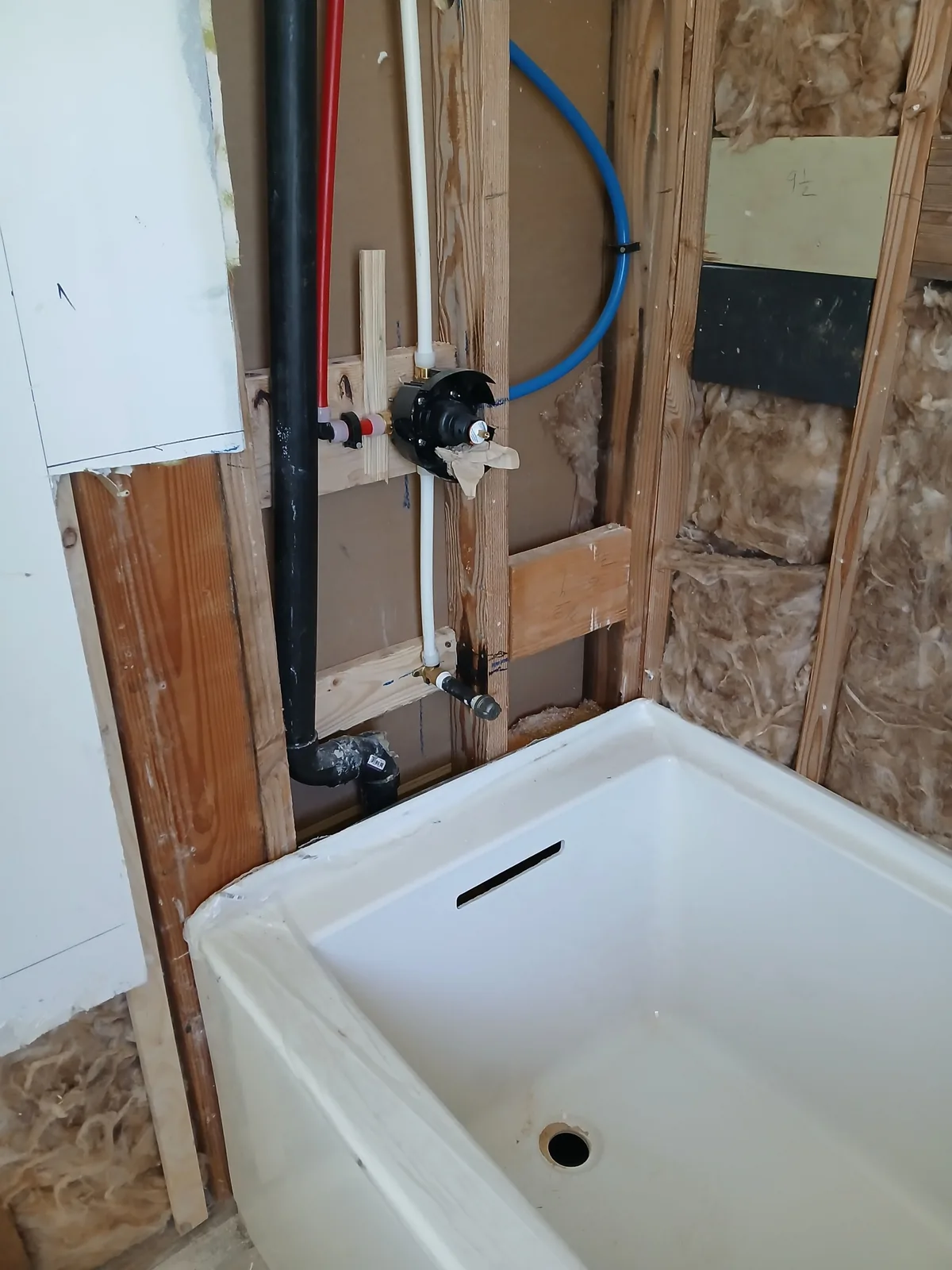
There is also a timing argument. If a bathroom or kitchen is being remodelled, the walls are already open. Repiping later means opening a finished room to reach the same runs.
What repiping actually involves
The scope is driven by layout and access more than by square footage. A single-storey house over a crawlspace is a very different job from a two-storey on a slab, because the second one has fewer routes that do not involve opening walls.
That is why we scope it after walking the property rather than over the phone — the run routing and the amount of wall opening drive the work, and neither is visible from a description.
It is permitted work. In unincorporated Sonoma County, Permit Sonoma's records show permits for both water repiping and sewer drain repiping, and its fee schedule lists water piping at $8.26 per unit against a $327 minimum trade permit fee. Incorporated cities run their own departments.
Does hard water make it worse?
It contributes. Local supplies run moderately hard to hard — California American Water at Larkfield reports 126 mg/L, about 7.4 grains per gallon, Santa Rosa around 112 mg/L, Valley of the Moon 109 mg/L. Scale deposits inside an already narrowing pipe compound the flow problem, and the same mineral content is what shortens water heater life in the same houses.
Related reading
Frequently asked questions
How long does galvanized pipe last? Service life varies with water chemistry and use, but galvanized supply pipe installed before about 1970 in the North Bay is generally at or past the end of its useful life now. The material is no longer used for new residential supply.
Is rusty water from galvanized pipe dangerous? It is primarily an aesthetic and plumbing problem rather than an acute health one, but it is a clear sign the pipe is deteriorating. If discolouration is constant rather than occasional, that is worth acting on.
Can you repipe just the hot side? Sometimes, and it can be a reasonable staged approach since the hot lines usually fail first. It is a partial answer — the cold lines are the same age and material.
Will repiping fix my water pressure? If the pressure loss is caused by corroded, narrowed supply pipe, yes. If it is caused by a pressure regulator, the supply itself, or a partly closed valve, repiping will not change it — which is why the cause gets established first.