
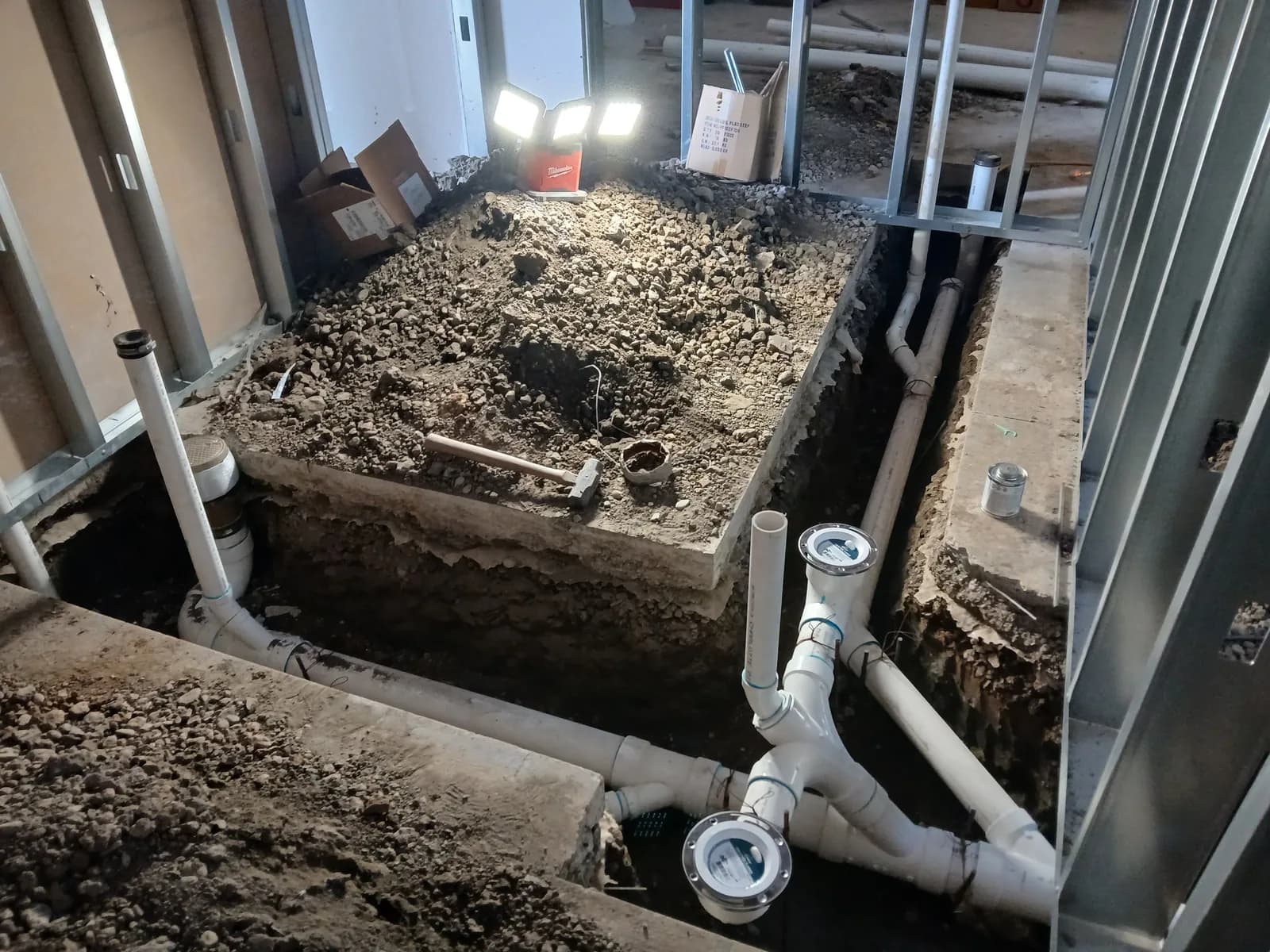
Food service premises are generally required to intercept grease before it reaches the sewer, and in Sonoma County that oversight runs through county and city programmes depending on which agency has authority over the address. The requirement, the sizing and the maintenance interval all follow the jurisdiction rather than the type of restaurant — which is why two kitchens on opposite sides of a city boundary can be held to different schedules. If you are opening, taking over, or remodelling a food premises, the grease interceptor is one of the first things to establish, not one of the last.
Why grease is treated differently from other waste
Cooking fats leave a kitchen as warm liquid and arrive in the line as solid. They coat the pipe wall, catch everything passing, and build until flow stops. In a domestic kitchen that means a slow sink. In a commercial kitchen running all service, it means a blocked lateral and a closed premises.
That is the reason interception is regulated rather than left to good practice — a single restaurant's grease affects the public main and everyone downstream of it.
Interceptor or trap?
The terms get used interchangeably and they are not the same thing.
A grease trap is the smaller under-sink or in-floor unit, sized for lower flow, and it needs frequent servicing because its capacity is modest.
A grease interceptor is the larger, usually external, in-ground tank sized for the whole kitchen's flow. Longer service intervals, considerably more capacity.
Which one a premises needs is a sizing question driven by fixture count and flow, and it is set by the authority having jurisdiction, not by preference.
What actually goes wrong
Servicing stretched too far. An interceptor that is not pumped on schedule stops intercepting. Grease passes straight through into the lateral, and the problem simply moves downstream where it is more expensive.
Wrong sizing from the start. An undersized unit needs servicing far more often than anyone budgeted, and it is usually discovered after the fit-out is finished.
Fixtures plumbed to the wrong side. Not everything should route through the interceptor, and things that should sometimes do not. This is a fit-out error that surfaces months later.
No records. Service records are what demonstrate compliance. Losing them is a problem separate from whether the servicing actually happened.
The rest of the commercial kitchen picture
Grease is one item on a longer list that separates commercial from residential work:
- Backflow prevention on most commercial connections, with annual certified testing filed with the water agency
- Floor drains and floor sinks, which need to actually drain under real service conditions
- Heavier fixture loads and larger pipe sizing than a domestic kitchen
- ADA requirements on restrooms
- Scheduling around trading hours, because downtime costs money directly
Shared laterals in multi-tenant buildings
Worth flagging for anyone in a shared building, because it causes disputes.
Where several tenants share a lateral, responsibility for blockages and for compliance work is frequently unclear until something fails. Some districts also apply additional programme requirements to commercial properties and to shared or condominium laterals — Sausalito–Marin City is explicit about this.
Establishing who owns what before a blockage is far easier than establishing it during one.
Related reading
- Commercial plumbing services
- Backflow prevention testing and installation
- Drain cleaning and hydro jetting
- Sewer camera inspections
Frequently asked questions
Who decides if my restaurant needs a grease interceptor? The agency with authority over the premises. Grease trap oversight in Sonoma County runs through county and city programmes depending on the jurisdiction, so the answer follows the address rather than the business type alone.
How often does a grease interceptor need pumping? It depends on size and how heavily the kitchen runs. The interval is set by the authority having jurisdiction and by actual accumulation, which is why keeping service records matters.
Can jetting clear a grease-blocked line? Yes, and it is the right tool — high-pressure water scours the grease off the full pipe wall rather than punching a channel through it. But if the interceptor is not doing its job, the line will grease up again.
Does a coffee shop or bakery need one? Possibly. It is driven by what goes down the drains rather than by what is on the menu, and it is a question for the jurisdiction rather than an assumption either way.