
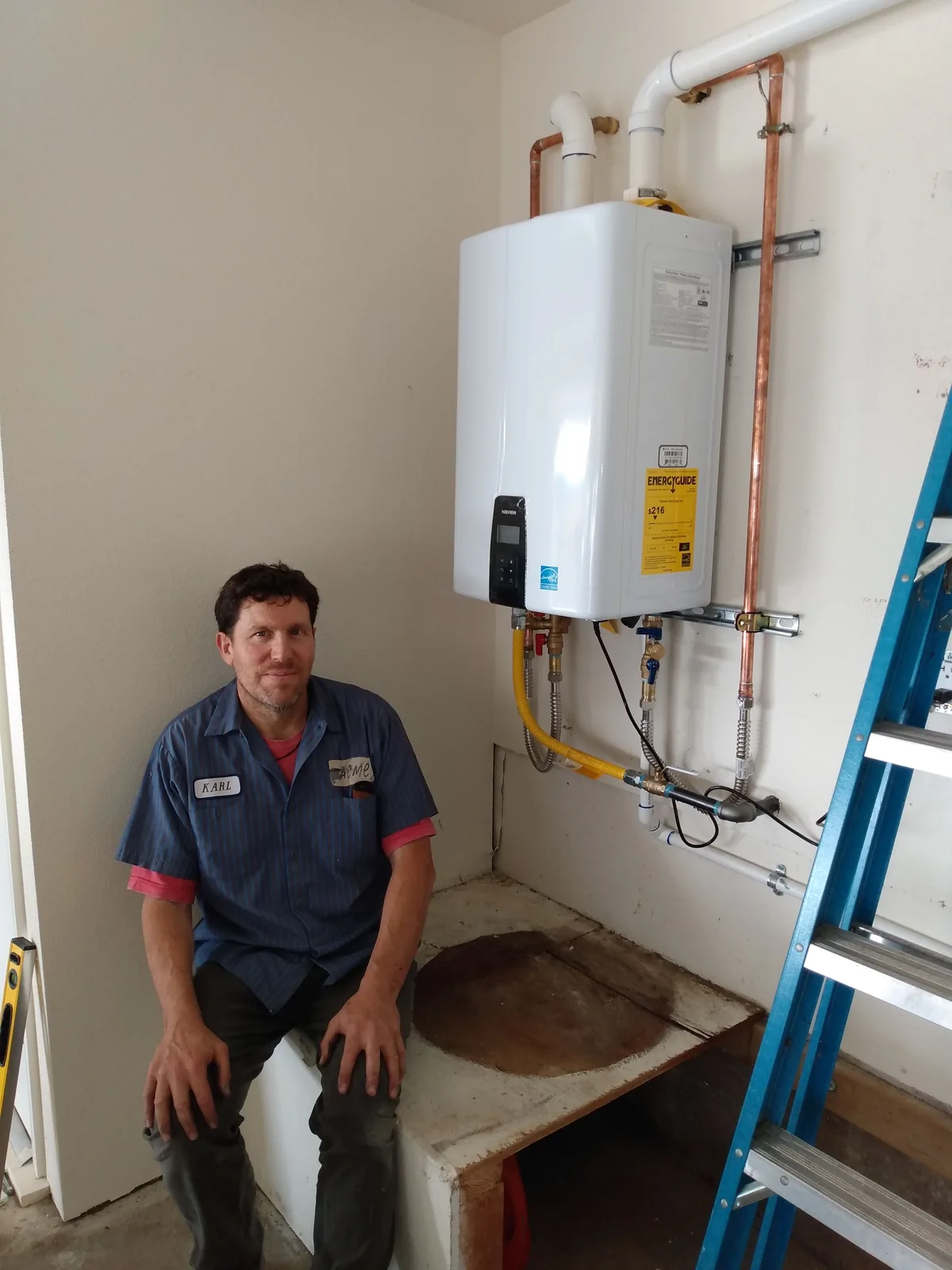
Tankless water heaters are generally documented at around 20 years of service life, roughly twice that of a conventional tank heater at 8 to 12 years. The reason is structural rather than marketing: a tankless unit has no steel tank standing full of heated water, so the corrosion process that ends most tank heaters simply is not present. What limits a tankless unit instead is scale on the heat exchanger — which means in a hard-water area like much of Sonoma County, the difference between a unit that reaches twenty years and one that does not is almost entirely whether it has been descaled.
Why the lifespan is longer
A tank heater fails because water sits in steel. A sacrificial anode rod protects the lining until it is consumed, then corrosion moves to the tank wall, and eventually the wall perforates. Nothing about that sequence is avoidable — it can only be slowed.
A tankless unit heats water on demand through a heat exchanger. There is no reservoir, no anode rod to consume, and no large steel vessel under constant thermal load. Most components are also individually serviceable, which is not true of a tank once the tank itself has gone.
What actually limits it: scale
Every pass of hard water through the heat exchanger leaves mineral behind. Scale narrows the passages, insulates the exchanger, and forces the burner to work harder for the same output. Left long enough it causes error codes, inconsistent temperature, and eventually exchanger failure.
Local hardness makes this a real maintenance item rather than a theoretical one:
- California American Water, Larkfield-Wikiup — 126 mg/L, about 7.4 grains per gallon
- Santa Rosa Water — around 112 mg/L
- Valley of the Moon Water District, Glen Ellen — 109 mg/L
- Marin Water — 58 mg/L for one reported source, 123 mg/L for another
A tankless unit in Larkfield needs descaling on a schedule. The same unit on the softer end of Marin Water's supply has an easier life.
What maintenance actually involves
A descaling flush circulates a descaling solution through the heat exchanger to dissolve accumulated mineral. Most manufacturers specify service intervals, and installations here commonly include isolation valves specifically so the flush can be done without breaking into the pipework.
If your unit was installed without isolation valves, that is worth correcting at the first service — it turns a routine job into an awkward one every single time otherwise.
The inlet filter screen also needs periodic cleaning, and on a gas unit the venting and condensate drainage should be checked.
Does that maintenance cancel out the longer life?
That is the fair question, and the honest answer is that it depends on the water and on whether the maintenance actually happens.
A tankless unit that is descaled on schedule in a hard-water area will comfortably outlive tank heaters installed alongside it. A tankless unit that is never touched in the same water will not reach anything like twenty years, and the failure when it comes is a heat exchanger rather than a cheap component.
The unit does not forgive neglect better than a tank does. It just fails from a different cause.
Signs a tankless unit needs attention
- Fluctuating temperature during a single shower
- Error codes on the display, particularly scale or flow related
- Reduced flow rate at the same fixtures
- Longer delay before hot water arrives
- The burner cycling more than it used to for the same demand
Related reading
- Water heater installation, tank and tankless
- Water heater repair and replacement
- Water softener installation
Frequently asked questions
How often should a tankless water heater be descaled? Follow the manufacturer's interval, and treat the harder end of Sonoma County as the demanding case rather than the average one. If a unit has never been descaled and is showing temperature swings, that is the first thing to check.
Do tankless units need an anode rod? No. There is no steel storage tank to protect, which is one of the reasons the service life is longer. Some hybrid and storage-type units do, so it depends on the design.
Is a tankless unit worth it if my water is hard? It can be, provided the maintenance is real rather than intended. Hard water does not rule it out — it raises the cost of ignoring it. A softener changes that calculation for the whole house, not just the heater.
What usually fails first on a tankless unit? Scale-related problems in the heat exchanger, followed by flow sensors and igniters. Most of those are serviceable, which is the practical difference from a tank heater where the tank failing ends the unit.