
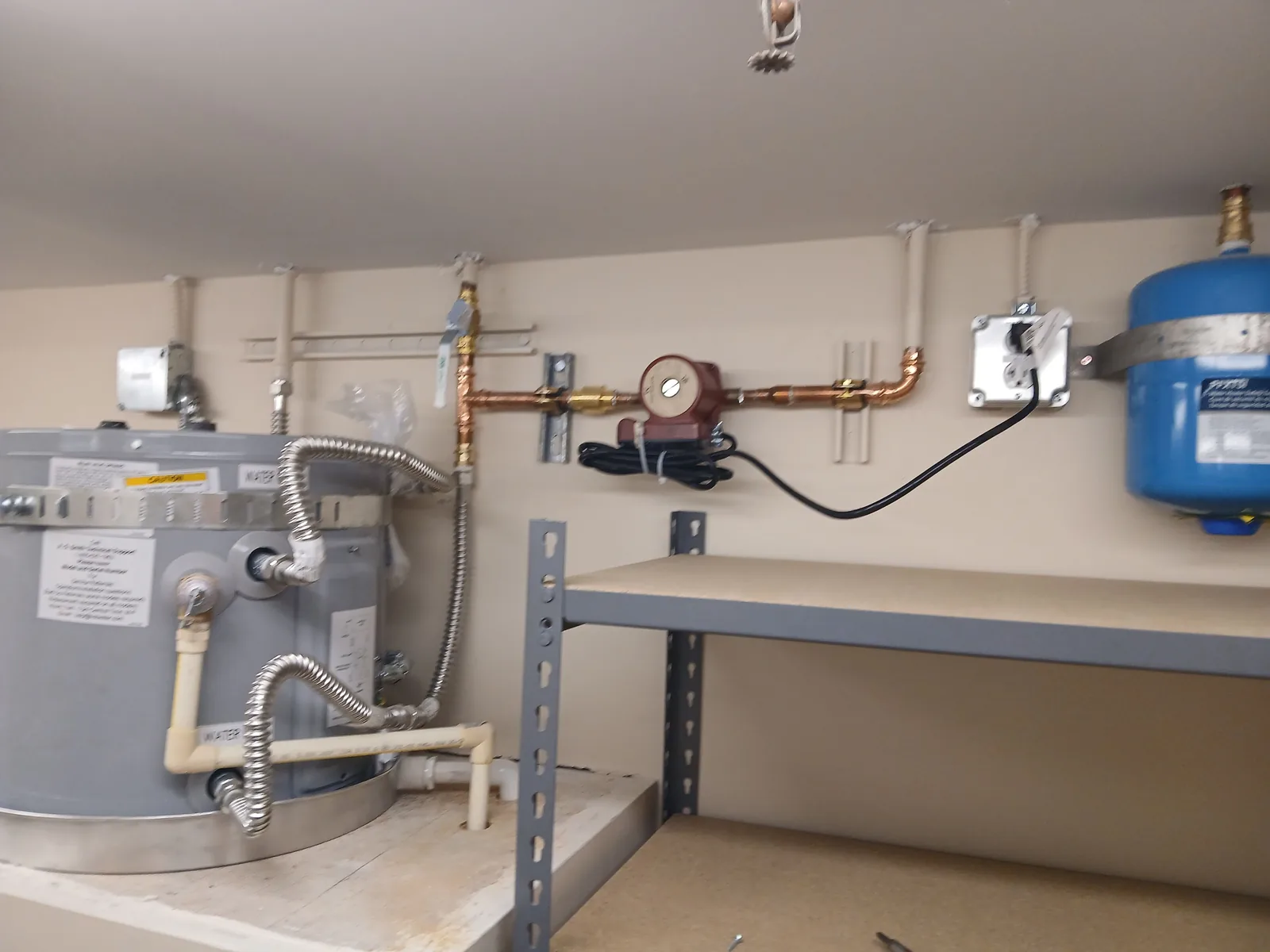
Water pooling at the base of a water heater almost always means the steel tank has corroded through, and a perforated tank cannot be repaired. That is the short answer, and it is worth knowing before anyone quotes you a patch. Unlike a leaking fitting or a weeping relief valve at the top of the unit — both of which are repairs on a sound tank — a leak from the bottom is the tank itself failing. What matters now is how fast you act and what is underneath it.
Rule out the two impostors first
Before accepting that the tank has gone, eliminate the two things that look identical on the floor:
Condensation. In humid weather, a tank full of cold incoming water sweats. Water appears at the base and looks exactly like a leak. Dry the tank and the floor completely, then watch it — condensation returns as an even film across the shell, not a running trickle from one point.
A drip from above. Water from a fitting, the relief valve or an overhead pipe runs down the outside of the tank and collects at the bottom. Dry everything, lay paper down, and look at where the first spot appears.
If the water reappears at the base with the top and sides dry, the tank is the source.
Why the bottom is where it fails
Sediment settles on the tank floor and stays there. Corrosion works underneath that layer where nothing can be seen or reached, and the sacrificial anode rod that was protecting the steel has usually been consumed years earlier.
By the time water appears, the wall has already perforated. There is no weld, sealant or epoxy that restores a vessel holding 40 to 50 gallons of heated water under supply pressure. Replacement is the only outcome.
How urgent is this?
Urgency is set by location more than by the size of the leak.
Lower urgency — a garage or utility space with a floor drain and a concrete slab. A slow seep here is a job for this week.
Higher urgency — a hallway closet, an interior room, an upper storey, or anywhere above finished flooring. A tank does not fail gradually to the end. It can go from weeping to releasing its full capacity in one step, and the supply keeps feeding it until someone closes a valve. The water damage below routinely costs more than the heater.
What to do right now
- Close the cold supply valve at the top of the heater. That stops it refilling.
- Gas unit — turn the gas control knob to off. Electric unit — switch off its breaker. Never leave an electric element energised in a draining tank.
- Do not stand in standing water around an electric unit until the breaker is off.
- Leave the T&P discharge line clear and pointed where it is meant to go.
- Call. If the unit is somewhere a full release would cause damage, say so when you call — it changes the priority.
Is there anything to salvage?
Occasionally what looks like a base leak is the drain valve at the bottom of the tank, which is a repair. It is worth checking, and we do check it, but it is the exception rather than the hope.
What replacement involves in Sonoma County
A replacement is permitted work. In unincorporated Sonoma County, Permit Sonoma lists a water heater and vent plumbing unit at $20.75 against a $327 minimum trade permit fee; the incorporated cities run their own departments. The inspection checks seismic strapping, the temperature and pressure relief drain line, an expansion tank on a closed system, venting and combustion air on gas, and a drain pan where a failure would damage the structure below.
That last item is worth taking seriously if the old unit has just proved the point.
Related reading
- Water heater repair and replacement
- Water heater installation, tank and tankless
- Leak detection and repair
Frequently asked questions
Can a water heater leaking from the bottom be fixed? If the source is the drain valve, yes. If the tank body has corroded through, no — and that is the more common finding when water appears at the base.
How long do I have before it fails completely? There is no reliable answer, which is the problem. A perforated tank can seep for weeks or open up the same day. That uncertainty is why location matters so much in deciding urgency.
Should I turn the water off to the whole house? Usually not necessary. Closing the cold supply valve at the heater isolates the unit and leaves the rest of the house working. If that valve is seized — common on older installations — then the main is the fallback, and the seized valve is its own thing worth replacing.
Does a drain pan stop the damage? It helps with a slow seep if it is plumbed to a drain. It will not contain a full tank release. It is a mitigation, not a solution.