
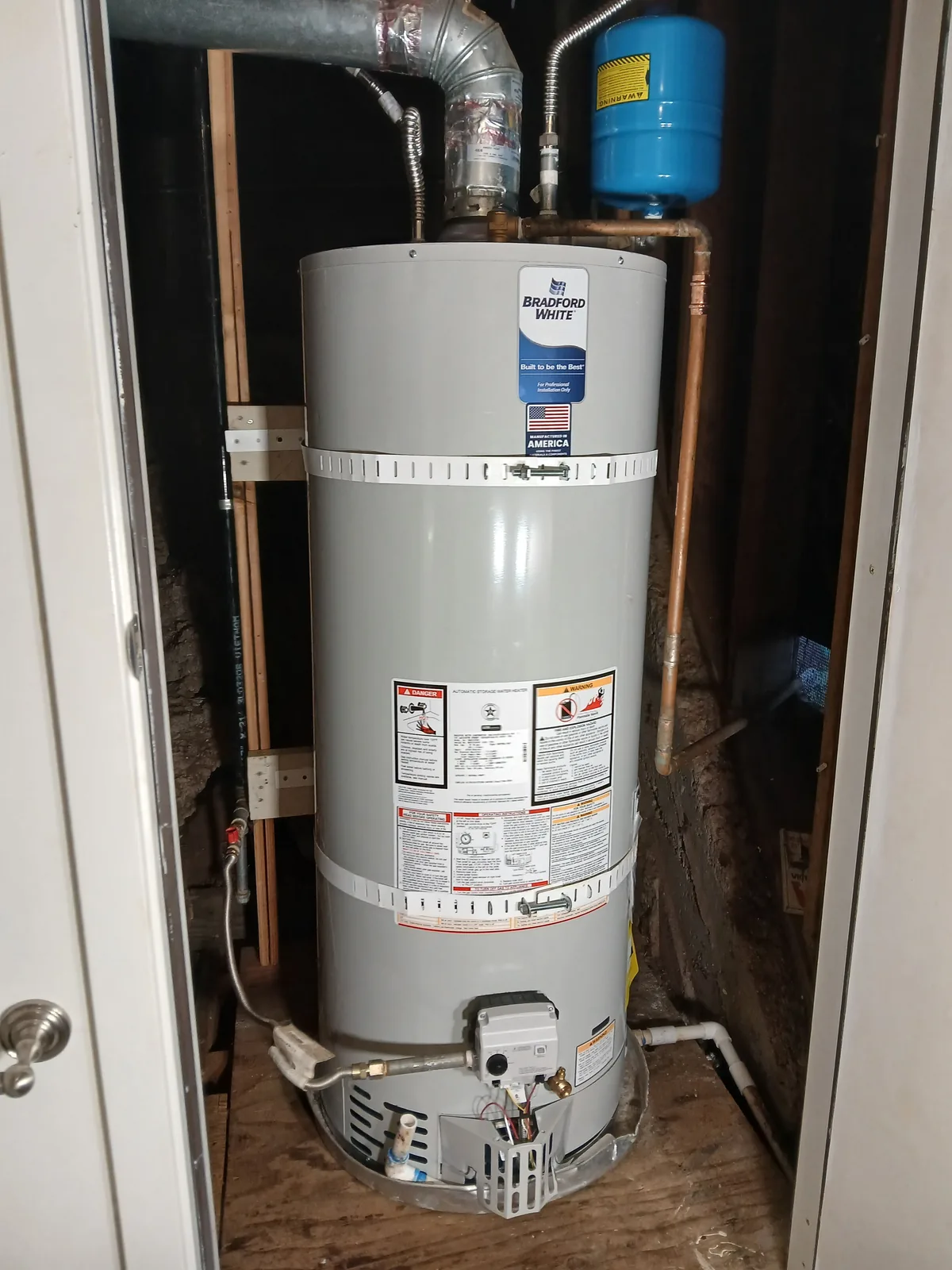
A leaking water heater is telling you one of two very different things, and where the water is coming from decides which. Water appearing at the top of the tank is usually a fitting, a connection or the temperature and pressure relief valve — all repairable on a sound tank. Water pooling at the base usually means the steel tank itself has corroded through, and that is not repairable at any age or price. So before anything else, dry the area completely, put paper down, and find out where the water actually originates. That single check is the difference between a service call and a replacement.
Water at the top: what it usually is
- The cold inlet or hot outlet connection. Threaded joints and flexible connectors loosen and corrode over time. Often a straightforward repair.
- The temperature and pressure relief valve. The T&P valve is a safety device that opens if pressure or temperature climbs too far. If it is weeping, it is either failing or doing its job because something else is wrong.
- The anode rod fitting, which can seep once the rod has been consumed.
A T&P valve that discharges repeatedly is not a nuisance to be capped. It is a signal. Excess pressure usually points at thermal expansion with nowhere to go, which is what the expansion tank on the cold inlet is there to absorb. California code requires one on a closed system, and a failed or waterlogged expansion tank shows up exactly this way.
Water at the base: what it usually means
Sediment settles on the tank bottom, and corrosion works underneath it where nothing can be seen. When the steel finally perforates, the water appears at the base of the unit.
There is no patch for this. Welding, sealants and epoxies do not restore a pressure vessel that holds 40 to 50 gallons of heated water. Once a tank body leaks, replacement is the only answer.
Before concluding the tank has failed, rule out two impostors: condensation on the tank in humid weather, and a drip from above running down the outside of the shell. Both look identical to a tank leak on the floor.
How urgent is it?
That depends on the tank's location as much as the leak.
A slow seep at the base of a heater in a garage with a floor drain is a job for this week. The same seep in a hallway closet on an upper storey is a job for today, because a tank does not fail politely — it can go from weeping to emptying its full capacity in one step, and the damage below is what costs.
If water is actively running: shut off the cold supply valve at the top of the heater. On a gas unit turn the gas control to off. On an electric unit switch off its breaker. Then call.
Why Sonoma County heaters fail early
Local water is moderately hard to hard. California American Water at Larkfield reports 126 mg/L, about 7.4 grains per gallon. Santa Rosa runs around 112 mg/L, Valley of the Moon in Glen Ellen 109 mg/L. That mineral content settles out as scale, insulates the tank bottom, and drives longer burn cycles and more thermal stress on the steel.
A heater that has never been flushed in a hard-water area has been aging faster than its warranty assumed.
What we check on a leak call
- Where the water is actually originating — top fittings, T&P, base, or something dripping from above
- Whether the T&P valve has been discharging, and why
- Whether an expansion tank is fitted and still functional
- The tank's age from its serial number
- Whether seismic strapping and the T&P drain line meet current California requirements, because a replacement will be inspected against them
Related reading
Frequently asked questions
Can a leaking water heater be repaired? If the leak is at a fitting, a connection or the T&P valve, usually yes. If the tank body itself is leaking, no — the steel has corroded through and no repair restores it.
Is a leaking water heater dangerous? A slow leak is mainly a water damage risk. A gas unit sitting in standing water, or a T&P valve discharging repeatedly, is a different matter and should be shut down and looked at promptly.
Why is my water heater leaking only sometimes? Intermittent water at the base is often the T&P valve discharging during heating cycles, or condensation in humid weather. Both are worth diagnosing rather than watching, because one is a pressure problem and the other is harmless.
How much water is in the tank if it fails? Whatever its capacity — typically 40 or 50 gallons on a residential unit, and it does not stop there, because the supply keeps feeding it until someone closes the valve.