
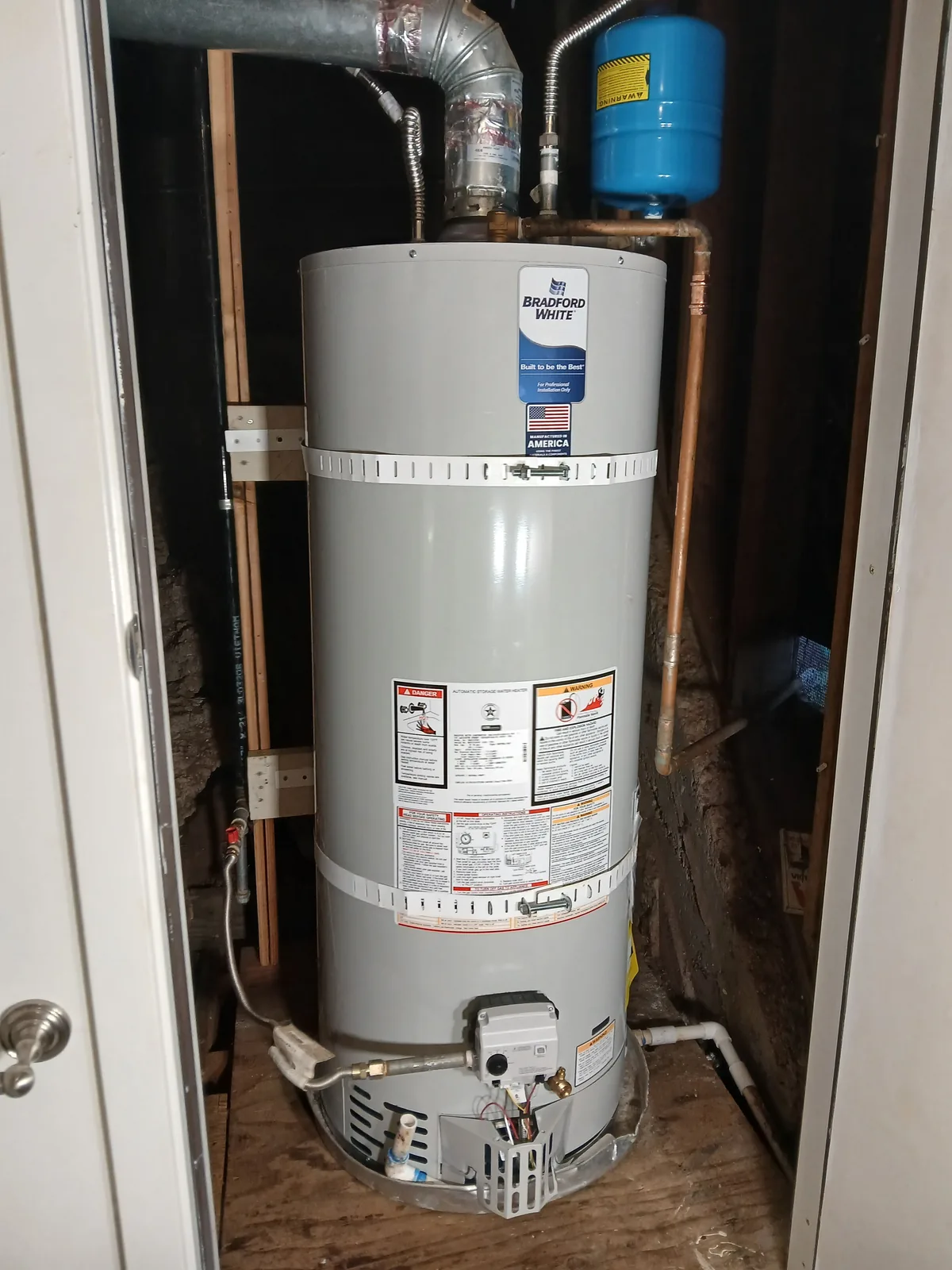
Most water heaters last 8 to 12 years. A tank heater in Sonoma or Marin County typically reaches the end of its life somewhere in that window, and the single biggest factor in whether it lands at the short end or the long end is how hard your water is and whether the tank has ever been flushed. Tankless units are documented as lasting roughly twice as long — often 20 years or more — because there is no steel tank sitting full of heated water waiting to corrode. If your heater is over ten years old, has never been serviced, and has started making noise or leaving rusty water in the first draw of the morning, you are near the end rather than at the start of a problem.
What actually kills a water heater?
Not the thermostat, and not the element. Those are repairs. What ends a tank heater is corrosion of the steel tank itself, and that process runs quietly for years before anything visible happens.
Inside every tank heater is a sacrificial anode rod — a length of magnesium or aluminium designed to corrode instead of the tank lining. Once that rod is consumed, the corrosion moves to the steel. By the time you see water on the floor, the tank wall has already failed, and there is no repair for that.
How does hard water shorten it?
Dissolved minerals drop out of solution as the water heats, settling as scale on the tank bottom and on the burner or element surface. That scale insulates. The burner then has to run longer to reach the same temperature, which means more fuel, more thermal stress on the steel, and a heater that ages faster than the calendar suggests.
Hardness varies more across our service area than most people expect:
- California American Water at Larkfield-Wikiup reports 126 mg/L, about 7.4 grains per gallon — the hardest documented supply we serve
- Santa Rosa Water reports around 112 mg/L
- Valley of the Moon Water District, which supplies Glen Ellen, reports 109 mg/L
- Marin Water blends sources and reports 58 mg/L for one and 123 mg/L for another
A heater in Larkfield is working considerably harder than one in a soft-water part of Marin, and it will show.
Does flushing it actually help?
Yes, and it is the only maintenance that meaningfully extends the life of a tank. Draining the sediment out once a year stops the scale layer building to the point where it insulates the burner. On a tankless unit the equivalent is a descaling flush, which matters more here than in soft-water regions.
The honest caveat: flushing a heater that has never been flushed in twelve years sometimes reveals a problem rather than preventing one. Sediment can be the only thing sitting over a corroded spot. That is not a reason to skip maintenance — it is a reason to start it early.
What are the signs it is nearly done?
- Rusty or brown water from the hot tap specifically, worst on the first draw of the day
- Rumbling or popping while heating, which is water flashing to steam under a sediment layer
- Water pooling around the base — this one is terminal, not a repair
- Recovery getting slower, so the same shower runs cold sooner than it used to
- Age past ten years with no service history
One of those on its own may be a repair. Three together, on a unit past ten, is a replacement conversation.
Should you replace it before it fails?
It depends on where it sits. A heater in a garage with a floor drain can reasonably be run to failure. A heater in a closet above finished flooring, or on an upper storey, is a different risk — a failed tank empties its full capacity onto whatever is below it, and the water damage costs more than the heater did.
Related reading
- Water heater repair and replacement — what we check before recommending either
- Do you need a permit to replace a water heater in Sonoma County?
- Water softener installation — if hardness is the underlying problem
Frequently asked questions
How long does a tankless water heater last compared to a tank? Tankless units are generally documented at roughly twice the service life of a tank heater, often 20 years or more, because there is no steel tank holding heated water. They do need descaling, and in hard-water areas like Larkfield that maintenance is not optional if you want the longer life.
Is it worth repairing a 10-year-old water heater? It depends what failed. A thermostat, element, thermocouple, anode rod or relief valve is a repair on an otherwise sound tank. A leaking tank body is not repairable at any age. At ten years with a component failure, the question is usually whether you want to spend on a unit that has most of its life behind it.
Does a bigger tank last longer? No. Capacity affects how much hot water you have, not how long the heater lasts. What extends life is water chemistry, flushing, and a working anode rod.
How often should a water heater be flushed? Once a year is the general guidance, and in the harder parts of Sonoma County that is worth keeping to. If a heater has gone many years without one, mention that when you book — it changes what we expect to find.